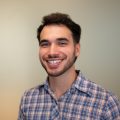
In 2019, Ukrainian entrepreneur and Muay Thai fighter Ilya Popov blocked a high kick in the final round of a kickboxing match in Thailand. The kick shattered the radial bone in Popov’s forearm and disrupted his semi-professional fighting career.
Popov, then 30 years old, had just sold his first startup business, a European booking site that helps athletes book accommodations in different languages. Back in Ukraine recovering from surgery, Popov planned his next venture.
His initial idea was for a medical device that could more precisely guide recovery from arm injuries such as his own. But a surgeon he interviewed steered him in another direction where innovation was lacking: lower-limb injuries.
The doctor explained that patients recovering from leg and hip injuries are often prescribed crutches and weight-bearing protocols that are difficult to follow. Apply 20% of your weight to your injured side for several weeks, for example.
“The only way physical therapists explain to patients how to do that is step on bathroom scale, try to remember that feeling, and walk like this, which is impossible,” Popov said.
So Popov came up with Smart Crutch Tips: sensors that can be attached to the end of crutches or a cane, able to measure the amount of pressure a patient is applying with each step. The device connects to a mobile app, which tells the patient when they’re stepping too lightly or too hard.
“I thought, here is an unmet need and opportunity,” Popov said. “I’m gonna sell it and become rich.”

Nearly seven years later, however, Popov is still struggling to turn it into a business. Before hospitals will use it, he has to prove to insurers that it will save them money.
It’s part of what makes medtech “an inherently more complicated system companies have to deal with,” said BioMedSA President Heather Hanson.
Popov is at least glad to be in good company. He moved to San Antonio in 2025 after living in New York City for three years.
“I feel here, a lot of support,” he said. “(Other startups) understand my pain, because they are also in this field and they know how difficult it is and how long it takes.”
By 2021, Popov had raised investments, built prototypes of his device and founded his startup, ComeBack Mobility. He recalls pitching his device to an orthopedic surgeon operating in Manhattan.
“Do you guys have patients who you prescribe partial weight-bearing prescriptions?” Popov asked the surgeon.
“Yes, a lot.”
“I have a medical device that is clinically validated, and that can help your patients follow your prescriptions,” Popov said. “Do you guys want your patients to be able to follow your prescriptions?”
The surgeon’s response: no.
“If my patients really follow my prescriptions, maybe the clinical outcomes would be worse,” the surgeon told Popov. “We don’t know.”
The surgeon’s point, Popov said, was that nobody really knows whether the standard prescriptions are right. The studies behind weight-bearing protocols had no reliable way to measure if patients were actually following the guidance.

“I just spent $3 million and three years of my life to develop the device, to pass FDA inspection, come up with this quality management system … (for) a device that nobody needed,” Popov recalled thinking around that time.
Getting weight bearing wrong has real consequences, explained Dr. Ravi Karia, chief of the Orthopaedic Trauma Division at UT Health San Antonio.
Too much weight following surgery can loosen or break the plates and screws holding fractured bone in place, which can mean another costly surgery. Too little pressure can lead to muscle wasting and an unnecessarily long recovery, especially in older patients.
“A lot of (the weight-bearing protocols) aren’t based on great science,” Karia said, “because there’s so many variables.”
Popov realized that his device could help resolve the surgeon’s uncertainty. He also realized that he would need a lot more data to make his device marketable in the U.S.
“To develop a new device, it’s the easiest part,” he said. “The hardest part is to collect statistically and clinically significant evidence to prove — to convince an old man who treats patients 40 years with this way. Now some guy from Ukraine came here and said, ‘Hey, surgeons, now you should treat your patients in a different way.’”
Proving it
Popov and his team dug into the research behind bone healing and eventually connected with UT Health’s Vaida Glatt, director of research in the Department of Orthopaedic Surgery. Glatt has published research on how bone tissue heals with loading, and how to measure it. She’s now the chief scientific officer for ComeBack Mobility.
Using CT scans and computer modeling, Popov and Glatt have modeled how much weight promotes healing and how much risks breaking a screw.
In a small pilot study at NYU Langone in New York, patients who received real-time feedback from the Smart Crutch Tips kept 73% of their steps within the prescribed range, compared with 21% for patients trained with a bathroom scale.
But proving that patients actually heal better requires more data, especially since Popov is banking on securing reimbursement from private insurers and the Centers for Medicare & Medicaid Services to really scale his business.
“They want to see how much money we can save them, and only then they would provide us with a reimbursement amount,” Popov said.
Meanwhile, simply existing on the U.S. market is expensive between FDA fees, HIPAA compliance and quality management, he said. ComeBack Mobility has raised about $3.5 million from investors and grants, and Popov said he has run out of money a dozen times.
His first startup took two years to go from idea to sale. This one is nearing its seventh year with almost no revenue. “Just science and researchers,” Popov said.

“If I knew this from the beginning,” he added. “I wouldn’t have launched this business.”
Smaller companies and startups new to the medtech world often find themselves too focused on the product itself before realizing it’s only one quarter of the battle, Hanson explained. BioMedSA has launched several programs to help San Antonio startups navigate these challenges.
“I’ve seen loads of medical devices that work well in the lab and even in the way the doctor (uses it), but they often don’t fit into most doctors’ care path process in treating the patient, and so the devices fail,” Hanson said. “It’s complicated.”
‘Continue my journey’
Popov used to have an office in San Antonio, but now he works from his apartment off Broadway, his boxing gloves and medals hanging behind him.
He currently has four ongoing clinical trials looking at outcomes for patients with different lower-limb injuries, all of them taking place in Ukrainian hospitals.
He is also seeking funding for another trial using his tech to look at meniscus tears at Brooke Army Medical Center, which could launch next year if funding is secured, Popov said.
The rest of the ComeBack Mobility team, about 27 people, work in Ukraine. Popov left his home country two days before Russia’s full-scale invasion in 2022. He had planned on staying longer. But an adviser told him it would be a good idea to keep his visit short as the Russian military had already built up forces along the country’s border.
Popov said going back would likely mean being conscripted. He said he feels he has more to offer outside of the military.
“If I go there, I wouldn’t be able to go out because I’m a young and healthy person,” he explained. “I just believe that I can bring much more value to my country, doing this business, doing clinical trials in Ukraine.”
Recently, Popov secured a partnership with the Medical Forces of the Armed Forces of Ukraine to help companies gather clinical data from patients in the war, which could help move military medical devices forward in development.
Although his startup is taking much longer than he anticipated, his initial plan has not changed: to get rich. “I don’t know how the universe gives me another investor or some grant or some opportunity where I can find new money and continue my journey,” Popov said.
But he is also excited about what the innovation could mean for patients and the field of orthopedics.
“Can you imagine?” he said. “We would really find the best approach on how to walk, how to step, and how to apply weight bearing to accelerate healing.”