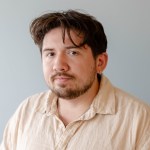
John Anthony Uriegas-Montez arrived at Crosspoint’s residential reentry center on April 7 after spending much of the previous seven years in and out of the criminal justice system.
By September, the 35-year-old San Antonio native had a full-time job operating a lift truck with health insurance and a logistics certification he earned through a Goodwill second-chance training program.
And after five months of living in a two-person room at a Eastside halfway house, he had secured an apartment of his own.
Sitting in the chapel, nearly everything he owned was packed into black trash bags and stacked on a table. After 4:30 p.m., he would be able to take them to his apartment and begin the next stage of his transition.

“This is my first step into trying to make it, “ Uriegas-Montez said.
His path through Crosspoint offers a glimpse into a less visible part of the criminal justice system: the transition between incarceration and returning to everyday life.
A step down from incarceration
Crosspoint has operated reentry programs in San Antonio since 1972. Often referred to as halfway houses, residential reentry centers provide a structured place for people transitioning out of prison or living under court-ordered supervision while they begin working, reconnecting with family and securing housing of their own.
The nonprofit holds a Federal Bureau of Prisons contract for its reentry program. Its men’s unit can house 85 residents at a time, while its women’s unit can house 35. Residents generally live two to a room and have access to laundry facilities and computers they can use to search for jobs. Unlike in prison, residents can also leave the facility to work, attend training and take care of other approved needs in the community.
Crosspoint Director of Operations Elisa Lopez-Canseco describes the program as a “decompression chamber” between prison and life on the outside.
“The whole goal is to get them ready for that release date,” Lopez-Canseco said. “Whether that’s reconnecting with their family members. Do they need counseling? Do they need some kind of reunification assistance? Just preparing them for that day.”

But that transition still comes with significant restrictions and expectations. Residents are monitored by GPS and must regularly account for where they are. Crosspoint staff conduct physical checks throughout the day, administer regular drug and alcohol tests and verify residents’ locations.
Employment is also an expectation. Residents who are able to work are expected to find a job, and those who are unemployed are required to actively look for one.
That level of accountability can make Crosspoint residents attractive to some employers, Lopez-Canseco said. Residents have their attendance at work monitored and verified and simply deciding not to show up for work can carry consequences that extend beyond losing a job.
“They want to employ our individuals because they can’t just call in. They have to work,” Lopez-Canseco said. “They don’t have the luxury of just saying, “I’m not going to go to work today.”
But finding that work can be difficult for people with felony records.
Crosspoint President and CEO Annette Rodriguez said one of the biggest barriers residents encounter is the stigma that is attached to having spent time in prison — a record that can follow them as they apply for jobs and housing, which often require background checks.
“Because they were in prison, because they were incarcerated, some think that they don’t deserve that second chance, or that they should be somewhere else and not within our community,” Rodriguez said.
That perception can obscure the roles people leaving prison play in the local workforce, she says.
“They may be serving you at a restaurant. They’re the ones that are helping in manufacturing plants and doing crucial work,” she said. “They are productive and contributing to our community in lots of ways and through different employment opportunities.”

Crosspoint tries to help residents navigate those barriers through a network of more than 100 community partners that connect them with job training, employers, housing assistance and other services.
One longtime partner is Goodwill, which sends representatives to the facility to connect residents with training programs for in-demand jobs that are open to people with criminal records.
Shortly after arriving at Crosspoint, a staff member introduced Uriegas-Montez to a Goodwill representative who regularly visited the facility. He took an assessment and enrolled in a Certified Logistics Associate program, training for work in warehouses and distribution centers.
He scored a 90 on the certification exam, but finding a job still required persistence.
Uriegas-Montez said he spent hours in Crosspoint’s computer room building a resume and submitting applications, sometimes aiming for as many as 30 in a day.
“Some people say, ‘Oh, I put one or two applications in,’” he said. “But you have to take into account the trial-and-error stage of that whole application process because some people are gonna read it, some people won’t.”

By June 3, less than two months after arriving at Crosspoint, he had landed a full-time job as a lift truck operator at Tindall Corp.’s San Antonio operation.
By the time he prepared to leave Crosspoint earlier this month, he had passed his 90-day mark and qualified for health, dental and vision insurance and other benefits. He was also looking ahead to earning a welding certification at St. Philip’s College, with hopes of eventually becoming a welding inspector.
Uriegas-Montez credits Crosspoint with putting some of those opportunities within reach. Had he gone directly to live with family after prison, he said, his transition could have placed another financial and logistical burden on relatives trying to help him get established.
Instead, he said, Crosspoint gave him a place where he could focus on workforce training, finding a job and getting back on his feet while living alongside others working toward similar goals.
“You come to a place like this and it’s kind of intimidating wanting to change and knowing you need to change,” Uriegas-Montez said “But that being said, there’s a smart rule in life: if you surround yourself with others that have the same goals and the same priorities, it will help you stay motivated and that’s worked out well for myself.”
Even with that progress, Uriegas-Montez said the reality of how quickly his circumstances had changed hadn’t fully hit him yet.
“Life definitely took off pretty fast in these last couple months,” he said. “When I really sit down and reflect upon it, I think it hasn’t dawned on me yet.”
A path that went off course
The path that brought Uriegas-Montez to Crosspoint was considerably longer than his stay.
His involvement with the criminal justice system dates back to 2010, when he was 19, and this wasn’t the first time he tried to build a different life.
Uriegas-Montez was convicted of misdemeanor graffiti that year. Around the same period, he began channeling his interest in graffiti into public art, working with San Anto Cultural Arts and other local organizations to paint murals around San Antonio.
In 2011, he helped restore End Barrio Warfare, a Westside mural centered on an anti-violence message. At the time, Uriegas-Montez spoke publicly about discovering San Anto Cultural Arts as a teenager and finding an outlet through mural work.
But his life did not continue along the path he envisioned then.

Over the following years, Uriegas-Montez accumulated additional convictions, including assault causing bodily injury to a family member and felony drug possession. He received deferred adjudication in the drug case in February 2020, but it was revoked later that year, resulting in a two-year state prison sentence.
He was released under mandatory supervision in early 2021, but was rearrested months later in New Braunfels while authorities were seeking him on a parole violation warrant. Uriegas-Montez was found in possession of two firearms, a violation of his parole and the Gun Control Act of 1968, which prevents convicted felons from being in possession of or owning firearms.
Uriegas-Montez eventually pleaded guilty in federal court to being a felon in possession of a firearm. In 2024, he was sentenced to 72 months in federal prison, with credit for qualifying time already spent in custody, followed by three years of supervised release.
The federal judge ordered him to spend 180 days at a residential reentry center, the requirement that eventually brought him to Crosspoint.
Uriegas-Montez said incarceration gave him plenty of time to consider what would have to be different when he got out.
“You have time taken away from you because you’re paying back your debt to society,” he said. “It was a lot of dwelling, and a lot of contemplating asking myself, how can I follow through with this? How do I make the next step work? How can I succeed doing this?”
Those questions followed him into Crosspoint where his ability to meet the requirements of his stay allowed him to be released from his 180-day stay early following his gainful employment and ability to secure an apartment.
Now he will spend the next three years of supervised release with one foot in the system. Some conditions of his release remain the same, he will still be required to maintain employment or actively seek it, live at an approved residence, submit to drug testing and treatment and comply with other restrictions imposed by the court.
What has changed, he said, is what he wants to build within those boundaries.
Financial stability is now one of his biggest priorities. So is reconnecting with his two children.
“I’m determined to get back in my kids’ life,” Uriegas-Montez said. “By the time they come around, or they’re allowed to come around, I want them to see that their dad is doing well.”

He has not abandoned art, either. Between work, training and the other demands of reentry, he said there isn’t much time for it now, though he still occasionally picks up a pencil or a paintbrush.
Uriegas-Montez doesn’t consider his transition finished. Instead, he describes what he has accomplished so far as the foundation for what he hopes comes next.
“I planted the seed. I nurtured the tree and watered the ground,” he said. “The fruit’s not there yet, but it’s coming. And when it does, it might not be the best thing, but it’ll come and at least I’ve already planted my roots.”