


For Marfa-based artist Julie Speed, all the world’s a puzzle.
A painter, sculptor, collage artist, and printmaker who has been exhibiting for more than thirty years, Speed is currently presenting a recent body of her provocative and at times humorously enigmatic art in tandem exhibitions at Ruiz-Healy Art in San Antonio through Saturday, March 19, and at Flatbed Press and Gallery in Austin through Thursday, April 7.
A feast for inquisitive eyes, Speed’s exhibition at Ruiz-Healy Art features both representational and abstract imagery, much of which is delightfully overloaded with painstakingly crafted details. An avowed advocate of the philosophy that art is as much for the viewer as it is for the artist, Speed is of the school of artists who revel in open-ended content.
Years ago, believing that her own interpretation is only one of many possibilities for understanding what we see in her artwork, she coined the term “parareality” to refer to each alternative potential meaning, with the idea that no single explanation is any more valid than another.
Although Speed set out to be an academically trained artist, having studied briefly at the Rhode Island School of Design in the late ’60s, she is largely self-taught. Married to a musician, she spent a lot of time traveling in the ’70s, until she and her husband settled in the music-centric city of Austin in 1978. Once rooted, Speed began devoting more time to honing her skills as a painter.
During the ’80s, the period when she began exhibiting, Speed concentrated mainly on images of the human figure and, in some of her earliest paintings, her influences are fairly easy to identify. In “Ring of Fire” (1985), a well-dressed couple standing in the rain on a beach in a circle of fire and holding an umbrella is an obvious homage to a visual artist and a musician, with the imagery recalling that of the Surrealist painter Rene Magritte, and the title inspired by the popular Johnny Cash hit.
While Magritte-like stylistic elements are also evident in the subsequent painting “The Grand Dragon Crossing the River Styx on His Way to Hell” (1989), as in the irrational river composed of watermelons, this is one of the few works in Speed’s oeuvre that was actually conceived in response to a specific issue — the horrific practices of the Ku Klux Klan. As has become her custom, Speed freely blends references from diverse sources and here joins a biblical image, a crucifixion, to a mythological place, the River Styx, to create a new fictional reality in which the Klansman is on the stake, with a Black rabbi and nun as overseers and the watermelons as symbols of racial stereotyping.


A number of Speed’s early paintings take on the guise of simple portraits. None, however, are of people who actually exist and the imagery is more complex that it might at first appear. In “Queen of My Room III” (1998) and “Please Help Me, My Brain is Burning” (1994), invented female characters appear isolated against barren backgrounds as they stare blankly towards the viewer.
As in “Ring of Fire” and “The Grand Dragon Crossing…,” both paintings use subtle references to fire to invite narrative interpretations suggesting, for example, that the women’s expressionless faces are masking something deeper. In “Queen of My Room III,” the woman holds a lit match, and her crown is actually made up of matchsticks. So reflective viewers may begin asking themselves, “Is she a housewife trapped in a prison of domesticity, or is she a self-anointed practitioner of arson?” Both explanations, as well as others, are legitimate.
And whether it is a crown, a halo, a hat, or simply her hair on fire, the flames behind the woman’s head in “Please Help Me, My Brain is Burning” hint at inner anguish and discontent, which is reiterated in the title phrase being inscribed in Latin and moving laterally through the subject’s ears.
As potent as potential narratives that may be extracted from Speed’s paintings seem to be, it would be to misconstrue the artist’s intentions to assert that, other than in a rare example such as “The Grand Dragon…,” iconographic content is a motivator of the work. First and foremost, Speed is a formalist, who develops a composition using a trial and error process that is based on aesthetic considerations. In “Queen of My Room III,” in fact, the inclusion of the woman’s hand with the match evolved from a desire for compositional balance. Only after it is in place does it begin to stimulate potential narrative or metaphoric content.

Speed’s delightful inventiveness when it comes to composition can be seen reaching a point of mastery in her ink and watercolor drawings of the late ’80s, where she subverted normal expectations by adding bits of color to isolated details within black-and-white compositions. While such compositional embellishments have become common features in today’s digitally manipulated imagery, Speed’s actions predate the digital era, and she works only with her hands, computers are verboten.
Patterns abound in these compositions as well, and the space is deliberately distorted. So nothing appears logical, as we have traveled through the rabbit hole and thus the questioning can begin. With the title phrase “She Asked Why,” in fact, Speed gives us a subtle directive to start imagining what might be going on, and she reinforces her instructions with the finely detailed book of questions on the woman’s lap, and the puzzled expression on her face as she ponders a sliced-open lizard.
In the ’90s, Speed expanded her repertoire of mediums to include three-dimensional objects. For one series, she filled shadow boxes with painted cutouts and actual thorns, which serve as architectural backdrops. “Thornboxes” (1992), for example, is a compositional hybrid of a Renaissance altar and a Joseph Cornell boxed assemblage.
Concealed behind glass and protected by a padlock, a secret narrative is taking place as two men stare silently at one another, their ears covered by the hands of others in a gesture that suggests the familiar cliché “Hear No Evil.” In the more minimal found object sculpture “The Reluctant Witness” (1999), Speed pays homage to the Surrealist objects of artists such as Man Ray, who created a number of metronomes with solitary eyeballs in the 1920s.
Although the temperament of Speed’s art is consistently offbeat and quirky, she is one of those artists who has no singular style. As a keen observer and admirer of all kinds of art, she has listed among her many influences Early Byzantine art, Northern and Southern Rennaissance painting, Russian art and icons, Mughal and Persian miniatures, Australian Aboriginal art, 19th century Japanese woodcut prints, Manet and Degas, and numerous twentieth century artists including Pablo Picasso, Kasimir Malevich, Otto Dix, Balthus, Francis Bacon, Lucien Freud, and the self-taught artist Bill Traylor.
So, it is not surprising that she can move back and forth with great ease between representational and abstract imagery, as she did in 2003 with the painting “Still Life with Suicide Bomber #3” and the painted collage “The Murder of Kasimir Malevich #8.”


Although still working improvisationally during the first few years of the Millennium, Speed could not avoid creating these darkly sinister works in response to 9/11 and its aftermath. The abstract painter Malevich was not murdered, of course, but using his geometric style as a compositional starting point, Speed created a haunting image of a torn-open envelope with tablets emerging from it , bringing to mind the nationwide scare over the terrorist mailings of Anthrax.
Since moving to Marfa in 2006, Speed has devoted a lot of her efforts to making painted collages from her extensive collection of book illustrations. Since “Speed’s Law” dictates that she must never destroy a perfectly good book, damaged editions and loose leafs purchased separately provide resource materials for her creative endeavors.
As always, a work begins as Speed finds an interesting image to cut out and move about freely on paper, which is often another illustration that serves as the initial starting point and backdrop for an invented scenario. In “Suzanna, Annoyed” (2012), which is on view at Ruiz-Healy, the nude figure of the mythological Danae was cut from an illustration of her as depicted by Titian and his workshop and superimposed over another classical scene, striking a fine balance between the dominant foreground and the recessive background.
To fictionalize the figure further, Speed painted over her face, giving her a disgruntled expression, and brought her flesh to life by coloring it with a faint rosy tint. In this tiny scale work, she also brilliantly activated the background with droplets of red and yellow paint to create miniature explosions that echo the woman’s obvious discontent. Although Speed titled the work after the biblical Suzannah, who was accused of debauchery by lying elders, the scene could just as easily be interpreted as a contemporary woman who is fed up with the abuses faced by women in a world dominated by male power structures.
Indeed, Speed’s imaginary narratives often seem so incredibly well suited to the current issues of the day. In the recent painting “Milky Way” (2014), Speed has put a beautifully contemporary spin on the kind of satire that was practiced in the 16th century by yet another “elder,” Pieter Brueghel the Elder. Like Brueghel’s “Blind Leading the Blind” (1568), in which foolish people follow their leader one-by-one into a ditch, Speed’s “Milky Way” similarly calls attention to the futility of human folly.
Reminiscent of today’s politicians, three male dignitaries from different cultures and time periods as indicated by their garb may be plotting the world’s future, as an angry woman (a Trump supporter perhaps?) cheers them on. While hungry dogs in the right foreground suggest that the power figures will ultimately swallow one another alive, skulls on the table and windows opening on to star-filled nighttime galaxies are reality-check reminders that all human activity is transient, that political tides come and go, and that life as we know it is just a momentary spec on the boundless universe of space and time.

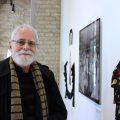
*Top image: Artist Julie Speed next to her piece “Milky Way,” 2014. Photo by David S. Rubin.
Related Stories:
Second Saturday Lifts Up Local, Latino Art
Corita Kent at SA Museum of Art: A Graphic Nun in a Mad Men World

David Rubin’s (no familial relation) take on contemporary art which I have followed for decades (lectures, writing, curating, as well as his own artistic practice) is simply awesome. Though Harvard trained (think connoisseurship) David is essentially a populist, albeit (in view of his training) perhaps with deeply buried elitist leanings. Hopefully so! I, on the other hand am a confirmed elitist with populist leanings. I still believe in the cannon, the stairway to heaven and above which the very best of art can take us. This said, David’s choice of contemporary artists and their art which he focuses on – given that 99 and 44 one hundred percent of all artistic outpourings will die an early, and necessary death – think Darwin’s Survival of the Fittest – is always choice. He has the eye and a simple, and straight forward way – no beating around the bush – with words which enable us to see what he is seeing and thinking, and as is often the case, what we are not. Just saying. PS I love Speed’s work. Edward Rubin, New York City
.