

This is the fourth story in a series about the way taxes, utility rates and fees are rising in San Antonio and Bexar County. You can read the first piece here, the second story here and the third one here.
Cooling property values and rising inflation left many local government entities scrambling to raise revenue wherever they could this year — some of which are now coming back down after voters’ pushback.
Changes local leaders made this fall are now showing up on property tax bills and utility statements that went out last month.
The San Antonio Report has been tracking what it all means for the average homeowner, who could pay roughly $129 more per year so far in taxes and other fees, according to our analysis.
Since we last did the math in early October, policymakers have had to contend with some harsh new political realities. Most notably, voters in four local school districts rejected tax rate increases on their Nov. 3 ballot.
Some of their residents are now receiving money back, said Tax Assessor-Collector Albert Uresti, because they’ve already paid property tax bills that went out before the election listing the higher rate.
“What we’re going to have to do now is send new bills to everybody reflecting the lower amount of taxes,” Uresti said. “People that have already paid their property taxes with the higher rate — we’re going to issue them refunds.”
The tax rate increases that the city of San Antonio, San Antonio River Authority and Alamo Colleges District all approved this year don’t require voters’ permission.
But city leaders are being extra cautious about measures still need voter support — including a $442 million bond program that’s expected to appear on the ballot in May 2027.
City leaders went with a bond proposal that’s a fraction of the size of their last one in 2022, and they even moved some drainage projects over to a stormwater bond that doesn’t require an election.
Days after the Nov. 3 election, Mayor Gina Ortiz Jones told TPR’s The Source that the city needs to “read the room” on residents’ financial anxieties and make a strong case for any projects they’re asking voters to help fund.

In addition to the failed school finance measures, Jones pointed to a hockey arena funding proposal that Plano voted down on the Nov. 3 ballot, and a public safety bond that failed in Dallas.
“I think it’s really important … whenever you’re talking about public dollars, you better have a real transparent process,” Jones said.
One bright spot for local ratepayers was CPS Energy, which came off the list after scrapping talk of a 2027 rate increase. Its leaders said they brought in some unexpected revenue, allowing them to delay a rate increase for another year.
That’s as SAWS just approved a 6.9% rate increase on water bills starting in 2027 — scaled back from a higher proposal several months ago.
Still, residents will already notice some higher fees on their utility bills that started last month. The City Council approved raising the parks and environmental fee and solid waste fees during their 2027 budget process, which took effect with the city’s new fiscal year on Oct. 1.
Since the San Antonio Report first analyzed the rate discussions taking place across the various taxing entities and utilities in June, the projected additional annual cost of taxes and fees for the average homeowner has decreased from about $168 per year to $129 per year.
Learn more about how the decisions were made and what increases are planned for the coming years in our roundup below.
Methodology: This story contains San Antonio Report calculations built from leaders’ public comments, presentations to the City Council, local school boards, the Alamo Colleges District board and other government entities. While the entities’ definitions of an “average” homeowner or ratepayer may vary, each increase cited is based off how local officials have said these changes will affect an average community member.
City of San Antonio
M&O property taxes
City Council approved a 3.9% property tax increase this year — the city’s first in more than 30 years. That’s in addition to major budget cuts and increased fees that were still needed to close a $158 million deficit over the next two years.
City leaders expect another 4.4% rate increase will be needed in fiscal year 2028.
City Council was deeply conflicted about whether to raise taxes, in part because some members thought there was more room to cut.

But after viewing an outline of the additional programs they could lose, a majority of the members decided deeper spending cuts would be more disruptive to their residents than a tax increase — though the vote was split largely along the city’s socioeconomic lines.
“[With a tax increase], the majority of our revenues will come from the largest businesses and corporations, the people who own and maintain larger and multiple properties, the people who have larger homes,” said Eastside Councilman Jalen McKee-Rodriguez (D2), who voted in favor of the rate hike. “If we implement any further cuts … the impacts will fall in Districts 1 through 5 — some of the most impoverished in our community.”
In addition to the tax increase and spending cuts, the new city budget uses an array of new or increased fees to generate additional revenue, including higher towing and impound fees, more expensive ambulance rides and new charges for nonresidents who use city libraries.
This budget also delayed the hire of new police officers that many council members consider crucial.
Current tax rate: The city’s total tax rate is currently $0.541590 per $100 of property valuation, including both the maintenance and operation and debt service portions of the bill.
How much? The new rate for 2027 is set at $0.56288 per $100 of valuation — a 3.9% increase.
The property tax bill for the average home with a homestead exemption, valued at $234,000, would go up by about $2.95 per month, or $36 per year, according to the city.
Properties without a homestead exemption including rental properties, second homes and businesses are likely to see a bigger increase.
Meanwhile, people ages 65 and older, as well as those who have a disability, who have a homestead exemption on their property, have their rates frozen.
That applies to about 47% of San Antonio households, which won’t see an increase on their bills, according to the city.
The city’s 2027 Taxpayer Impact Statement can be viewed here.
City bond
San Antonio considered raising another part of its tax rate to fund infrastructure needs, but ultimately decided against it.
Instead, City Council is instead asking voters to approve a $442 million bond in May 2027 — matching the amount city budget writers say they can safely afford while maintaining the existing debt service portion of the tax rate.
Bonds are money borrowed against future growth, something that’s normally reliable in a fast-growing city.
But slowed economic growth and cooling property valuations meant that San Antonio’s capacity for this five-year bond program was the lowest it’s been in two decades.
The council considered going for a roughly $1 billion bond — closer to what they approved in 2022 — but it required giving staff permission to raise rates as high as is needed to repay bonds.
According to a Sept. 30 presentation, San Antonio would need appraisal values needed to grow between 2% and 3.5% per year to sustain a $1 billion bond without raising rates, and values are currently trending the opposite direction.
An early breakdown of the 2027 bond priorities shows specific streets, drainage, parks and municipal facilities.
About $35 million is set aside to unlock state TxDOT grants for projects related to the sports and entertainment district known as Project Marvel, after city leaders struck an $85 million parking garage and a complete renovation of Durango Boulevard.

A citizen bond committee will be responsible for the final project selection, but with less money this year, there are fewer decisions to be hashed out through that process.
Voters have the ultimate say on a bond program, and they haven’t rejected one in San Antonio since 1979.
Current rate: The debt service portion of the tax bill is currently set at $0.21150 per $100 of valuation.
How much? The proposed $442 million bond would not raise the debt service portion of residents’ tax rate, however, some drainage projects were moved over to a stormwater bond that does involve raising rates.
Stormwater fee
The stormwater fee on residents’ water bills is a late addition to this list, and doesn’t require voter approval.
It was established in 1993 to fund the drainage and flood control systems that the city is required to maintain, but it’s been two decades since the city had a stormwater bond separate from its general obligation bond.
The idea of increasing it was raised at the beginning of 2025, was skipped over in the city’s 2026-2027 budget proposal, but then later revived in bond conversation, with fees now expected to go up in 2028.

San Antonio experienced one of the most deadly summers in decades in 2025 due to flooding. Yet traditional funding sources, like the budget and bond, are already stretched thin, and San Antonio hasn’t received much help from the state or the federal government to pay for drainage projects in recent years.
The proposed stormwater bond would provide $208 million for projects in the city’s unusually small 2027 bond program.
The city’s Storm Water Advisory Board just completed a new matrix to rank flood control projects by need.
Current: According to a Jan. 21 presentation from city staff, the last stormwater fee increase was in 2020.
Residential properties are categorized into three tiers, with most falling in Tier 2, which pays $4.94 per month, or about $59.28 per year.
How much: Rates are now expected to increase 5% in 2028 and 2029, then 3.5% in 2030 and 2031, and 3% in 2032. That’s larger than when the city first presented its plans earlier this year.
In 2028, the average residential rate will go up 25 cents per month or $3 per year.
By 2032, it will have risen $1.08 per month, or $12.96 per year.

Parks and environmental fee
The 2027 city budget also increased the parks and environmental fee collected on residents’ CPS Energy bills, which helps fund tree maintenance and operate the city’s park system.
Two years ago, the city took some heat for pulling money from its tree canopy fund and using it to landscape a gorilla enclosure at the San Antonio Zoo.
This year money is moving around again.
The city’s budget review identified “inefficiencies” to cut spending in the parks and environmental fund, but staff also plans to move some general fund expenses over and pay for them through those restricted dollars. The details are outlined in a Sept. 9 presentation.
Current fee: San Antonio’s parks and environmental fee was $2 per month before the change this year.
How much? The city is raised the fee 25 cents per month, or $3 per year. Another increase has been discussed for 2028, according to city budget presentations.

Trash fee
The 2026-2027 budget raises the solid waste fees to keep up with growing costs of services.
This will show up as both a higher monthly bin fee, as well as a higher monthly environmental fee, on residents’ CPS Energy bills.
Current fee: Trash bin fees vary by size, ranging from $14.75 per month for a small 48-gallon cart to $20.26 per month for a medium 64-gallon cart, to $30.75 per month for a large 96-gallon cart.
The environmental fee is currently $3 per month.
How much? Cart fees are going up by 75 cents per month, regardless of the size.
That brings them to $15.50 per month for a small 48-gallon cart, $21.01 per month for a medium 64-gallon cart and $31.50 per month for a large 96-gallon cart.
The environmental fee is going up to $3.25 per month.
Combined, the total cost is about $1 more per month for a household with one bin, or $12 per year.
Bexar County
Bexar County property taxes
Bexar County leaders staved off a property tax increase this year by dipping into their reserves, but retiring County Manager David Smith told commissioners it’s unlikely they can avoid one for long.
This year Smith reported the worst financial year since the 2008 market crash, with declining property values leaving the county with less revenue than the previous year.
“We don’t often experience a literal drop in property tax revenue,” Smith told commissioners headed into this budget season. “We’ve experienced declining growth. We’ve experienced stagnant growth. But a literal drop — even though it’s a small one — is unusual for us.”
Smith presented a budget that kept the rate even by freezing new capital projects, forgoing cost of living pay increases for the county’s roughly 5,000 employees, and taking about $68 million from the county’s rainy day fund — something he conceded is unsustainable long term.
Commissioners largely adopted those recommendations and slashed staff from a new health department the county stood up several years ago with pandemic relief funding.
Smith, who is retiring this year after his 30th county budget cycle, said the county will likely need a rate increase in the near future to fund major infrastructure needs for roads and flood control in the fast-growing unincorporated parts.

Notably, even Republicans’ Bexar County Judge candidate Patrick Von Dohlen was skeptical about promising to stave off a rate increase again next year.
“I’m opposed to any tax increases, and while I can’t guarantee that that’s not the case, anything like that would be incumbent [on having] a vote of the people before doing that,” Von Dohlen said at an Oct. 15 debate.
Von Dohlen lost to incoming Democratic County Judge Ron Nirenberg, who said a rate increase isn’t necessarily a foregone conclusion, but “all options have to be on the table if we are looking to create a healthier environment for this community.”
Current rate: Bexar County’s current tax rate is $0.276331 per $100 of valuation.
How much? Since property values have gone down, keeping the rate even means the average Bexar County home could pay less in property taxes this year.
Uresti said the average Bexar County home with a taxable value of $266,000 — after applying the homestead exemption — will see a $9 decrease in its annual property tax bill, or 75 cents per month.
Alamo Colleges District
Alamo Colleges District, which includes all Bexar County taxpayers, approved an 8.76% tax rate increase this year — its first in more than a decade.
A tax rate increase of that size does not require voter approval, only a board supermajority, which it received in September.

Trustees initially thought the increase would be lower, but the district’s growth continues to outpace its revenue, with tuition and fees frozen at the state level, and state revenue is falling short by millions of dollars for the upcoming academic year.
That contributed to a $27 million budget deficit headed into its 2027 budget cycle.
Current rate: Alamo Colleges’ current tax rate is $0.149 per $100 of valuation.
How much? The new tax rate for fiscal year 2027 will be $0.167 per $100 of valuation.
For homeowners, the increase will result in a $37 annual increase for homes valued at $270,000, the current median home value, or $48 more annually for a home valued at $320,000.
Hospital district
Bexar County Hospital District, which does business as University Health, has kept its tax rate steady for several years. A University Health spokesperson said the tax rate will remain the same this year.
“Only 16% of University Health’s revenues came from property taxes in 2025,” University Health spokesperson Elizabeth Allen said. “The rest was from patient revenues, private insurance, Medicare, Medicaid and other payment programs.”
The public hospital system is in the process of getting three new hospitals up and running. University Health’s budget is managed by a seven-member board of managers appointed by the Commissioners Court. The organization runs on a January to December budget cycle.
Current rate: $0.276235 per $100 of valuation.
How much? No increase.
San Antonio River Authority
The San Antonio River Authority is responsible for managing the San Antonio River Basin, and in the face of a deadly flood last year, continues to face big pressure executing major flood mitigation and response efforts.
At the same time, it’s expected to bring in less revenue this year — leading the board to approve a tax increase for the second year in a row.

The agency collects revenue from several sources, including property taxes from a four-county jurisdiction made up of Bexar, Karnes, Wilson and Goliad counties.
Last year, Bexar County leaders gave it an additional $21 million to fund the River Authority’s NextGen flood warning system — a response to the summer’s flood deaths — but the agency had to raise taxes so it could fund the same efforts in the other three counties, said Deputy General Manager Rick Trefzer.
Trefzer initially said they wouldn’t need another tax increase this year, but after property valuations were finalized, the agency was poised to bring in $900,000 less than the previous year if it kept the rate the same.
Some also feared that if they waited, state lawmakers could change laws currently allowing them to grow their revenue at a higher rate than cities and counties.
Current rate: The River Authority’s current rate is at $0.0183 per $100 valuation.
How much? The River Authority’s board approved a 5.46% increase for fiscal year 2027, bringing its rate to $0.01930 per $100 valuation.
For the average home in the river authority’s four-county jurisdiction, valued at $326,888 with a homestead exemption, that’s expected to result in a $2.77 increase per year, according to a River Authority spokeswoman.
Utilities
San Antonio Water System (SAWS)
SAWS had to pivot after its initial plan to invest in its infrastructure was voted down by San Antonio City Council in June. The utility knocked off $600 million from that proposal and City Council approved a lower $2.6 billion plan in October.
Projects range from replacing water mains and upgrading pump stations to retrofits of water recycling plants.
To pay for it, SAWS will raise rates starting in January, with additional increases scheduled between 2027 and 2030.
SAWS will raise the average residential monthly bill by $3.91, or 6.9%, starting in January and $3.94, or 6.5% in 2028. Rate adjustments in 2029 and 2030 are flexible. By the time the plan ends, the average monthly residential bill is projected to grow by between $13.45 and $16.54.
SAWS Officials said rate increases would probably be higher than $13.45 per month by 2030 due to inflation affecting the cost of infrastructure projects, but the utility will have to prove its need for funding to city staff every year between 2027 and 2030.
Most residents will have increases below that average, because a few high water users pull that number up. In its first proposal, average monthly rates were set to increase by $14.90 by 2030.

Current: The last time SAWS raised rates was in 2020, taking the average monthly residential water and sewer bill from $65.83 to $72.38, according to the utility.
How much? The plan approved by City Council would raise the average residential bill by $3.91 per month, or $46.92 per year, in the first year after it’s implemented.
Bills would continue to increase gradually over the coming years, and SAWS could use a range of available rate increases — from 4.5% to 6.8% in 2029 and 4% to 6.2% in 2030 — to meet their needs. Officials said because of the City Council delay, the increases in those years were more likely to be at the top end of that range.
The utility estimates that the average residential bill would climb $16.54 per month, or $198.48 per year, by 2030.
SAWS has a rate calculator on its website that allows customers to see how their own bills would change, though it requires the customer to pull some technical information from the second page of their bill.
CPS Energy
Since we first started this list, CPS Energy has scrapped talk of a rate increase in 2027.
CPS Energy had enough financial flexibility to push its rate increase down the road, the public utility’s staff told its board at an Oct. 26 meeting, after $170 million in incentives and other savings helped close its budget gap.
“We had unexpected favorable circumstances this year that allowed us to navigate this year without a rate request, but we expect that we will need to have that conversation for next year,” Chief Financial Officer Debra Wainscott told the utility’s board.
Wainscott said the utility would revive discussions next year after seeing a gap in its preliminary 2028 budget from slower customer growth and falling residential and wholesale revenues.
She added that inflation has increased costs, high interest rates have made it more expensive to invest in upgrades and an increase in energy supply across the state was lowering the cost of energy.
“The decision to defer the fiscal year 2027 rate request did not eliminate the underlying pressures facing the organization,” she told board members on Nov. 16.
CPS Energy is already dealing with a shortfall. The board took heat earlier this year for approving a fiscal year 2027 budget that includes a $50 million shortfall — which some city leaders equated to forcing their hand on a council-approved rate increase.

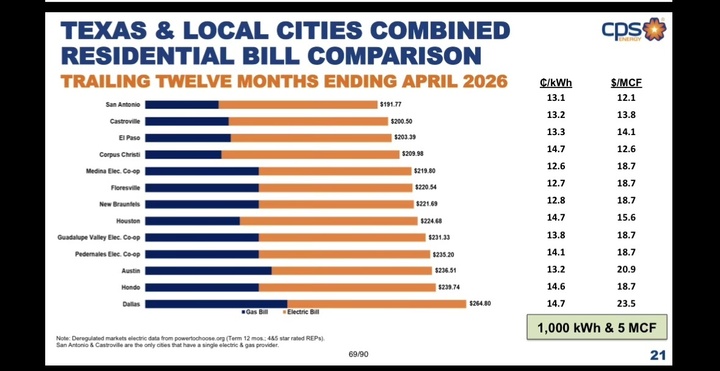
Current: At a June board meeting, CPS Energy officials touted an average monthly bill of $191.77 as being lower than other Texas cities.
That status looked in jeopardy when Gov. Greg Abbott made a campaign promise this year that would have upended CPS Energy’s business model — but then Abbott lost his reelection race, which city leaders consider a crisis averted.
How much? No increase in 2027.
School districts
Five San Antonio-area school districts pursued Voter-Approval Tax Rate Elections on the 2026 midterm ballot, but four of those measures failed — in Northside, San Antonio, East Central and South San ISDs.
A fifth district, Schertz-Cibolo-Universal City, approved theirs narrowly.
By law, school budgets had to be approved months before the election.
That means property owners have already received tax bills assuming the increase in these districts, and revised bills must now go out in the districts where they failed.
Three school districts with bond propositions on the Nov. 3 ballot also saw them fail: Northside, San Antonio and Comal ISDs.
Many district leaders are still reeling from the failed funding measures — while hoping for help from a new administration of state leaders with backgrounds in public education.
Northside ISD
Northside ISD asked voters to approve a 3-cent tax increase and an $883 million bond election in November.
The district said the proposed tax increase would unlock an extra $21.5 million for pay increases for teachers and auxiliary staff, some of which make less than $15 an hour.
On the bond side, NISD is proposing an $886.2 million package to pay for new vehicles and technology, facility improvements and a new natatorium.
How much? No increase, because it was voted down.
If voters had approved the VATRE, their tax rate would have gone from $1.0049 to $1.0349 per $100 of taxable property value. The district said that would increase property tax bills by approximately $30 per year for every $100,000 in home value.
The bond proposals don’t require a change in the rate, but also failed.
San Antonio ISD
San Antonio ISD officials pitched a 3.17-cent tax increase and a $600 million bond election on the November ballot.
The district faced a budget deficit because of declining enrollment, largely flat state funding and rising costs. At more than a century old, it also has aging buildings, increasing their maintenance costs.
Only a few months ago, SAISD felt positive it could go out for a bond of $450 million without requiring a tax rate increase. District leaders instead opted for a larger ask, which would incur a 6-cent increase to the I&S rate, implemented over the next three years.
Voter Guide: Understanding the 2026 San Antonio ISD bond and VATRE election
How much? None, because the measures were voted down.
If the voter-approval tax rate election and all three bond measures had passed, SAISD’s tax rate would have gone from $1.1552 to $1.6437 per $100 of taxable value by 2030 for homeowners in the district.
For an average home of $240,000, that would have been approximately $70 more annually, or $5.83 per month.
South San Antonio ISD
South San Antonio ISD asked voters to increase its maintenance and operations rate by 7 cents.
This would have generated an extra $2.7 million a year the district said was needed for urgent school roof repairs and raises for paraprofessionals, teaching and instructional aides.
South San ISD is currently under state control after years of financial mismanagement and board dysfunction. While not in a budget deficit, state-appointed superintendent Raul Hinojosa has been pushing for the rate increase to generate extra dollars for pay, facilities and student programs.
How much? None, because the measure was voted down.
The district’s current tax rate is $1.1959 per $100 of taxable property value. That rate is divided in two smaller rates: $0.4990 on the I&S side and $0.6960 on the M&O side.
South San’s proposed increase sought to move pennies from the I&S side to the M&O side, which district officials said wouldn’t significantly increase costs for the average homeowner.
East Central ISD
After going out for a VATRE that voters rejected last November, East Central ISD came back on the ballot with a smaller ask this year.
As one of few districts that’s actually growing in enrollment, ECISD asked voters to approve adding 3.72 cents to the maintenance and operations rate, which would have unlocked an extra $8.47 million a year.
To avoid a large increase, ECISD’s board decreased its interest and sinking rate by 3.71 cents, so if voters approved the changes in November, their rates would only go up by a fraction of a penny.
ECISD officials say the extra money would help the district keep up with inflation, maintain a performance-based compensation plan, hire armed security officers and maintain or even reduce class sizes by hiring more teachers.
How much? None, because the measure was voted down.
If VATRE had passed this year, ECISD’s total tax rate would have gone from $0.9319 to $0.9320 per $100 of taxable value.
For the average homeowner in ECISD, approval of Prop A would have meant less than $1 a year difference, officials said.
Schertz-Cibolo-Universal City ISD
Schertz-Cibolo-Universal City ISD, a semi-rural district on the far East Side of Bexar County, was the only district in this area to see its tax rate increase approved.
The district proposed a 12-cent increase to its M&O rate, which is expected to generate an additional $15 million a year for the district.
It was a larger ask than last year, when the district put a 6-cent VATRE on the ballot that voters ultimately rejected.
District officials say the extra funds will go toward employee pay, staff retention and student programs like fine arts, career and technical education and athletics.
How much? The district’s tax rate will go from $1.0769 to $1.1969 per every $100 of taxable property value for homeowners in the district.
For an average home of $317,335, that is approximately $216 more a year after homestead exemptions, or $18 per month.
Law enforcement
Last year, the City of San Antonio raised parking ticket prices, as well as fees on alarms and permits, to shore up its budget. Further fee increases were presented in this year’s budget, expected to generate $30.4 million over the next two years.
Bexar County just rejected a plan to raise more revenue by writing more tickets.
County Precinct 3 Constable Mark Vojvodich also said he’s also not going forward with a plan to bring in revenue by signing up for an expanded federal immigration enforcement partnership.
How much? San Antonio’s 2027 budget includes a long list of increased fees on everything from ambulance rides to booted vehicles to parking tickets. That list was even expanded in the final weeks to help pay for the cost of the City Council’s budget amendments. They take effect Oct. 1.
Disclosure: The River Authority’s Rick Trefzer serves as treasurer on the Texas Public Radio board of directors.