The San Antonio City Council unanimously voted Thursday to propose a property tax rate of $.54159 per $100 of valuation for the 2024 fiscal year, down from the 2023 fiscal year rate of $.54161 per $100 of valuation.
The move comes as the city’s General Fund is expected to increase by 5.3%, including major investments in public safety and proposed increases to residents’ solid waste fees. The city’s overall budget, which includes capital projects, is expected to increase by about 9%.
So how do the numbers work out? And does a reduced rate mean lower property taxes?
San Antonio’s General Fund comes from three major revenue sources: property taxes, sales tax and money the city receives from CPS Energy, which the city owns.
“We are one of the very few cities in the state that has three main revenue sources. Most large major cities in the state rely solely on property and sales tax,” said City Manager Erik Walsh. “The benefit that we have of being good stewards and owners of CPS allows us to mitigate revenue impacts elsewhere.”
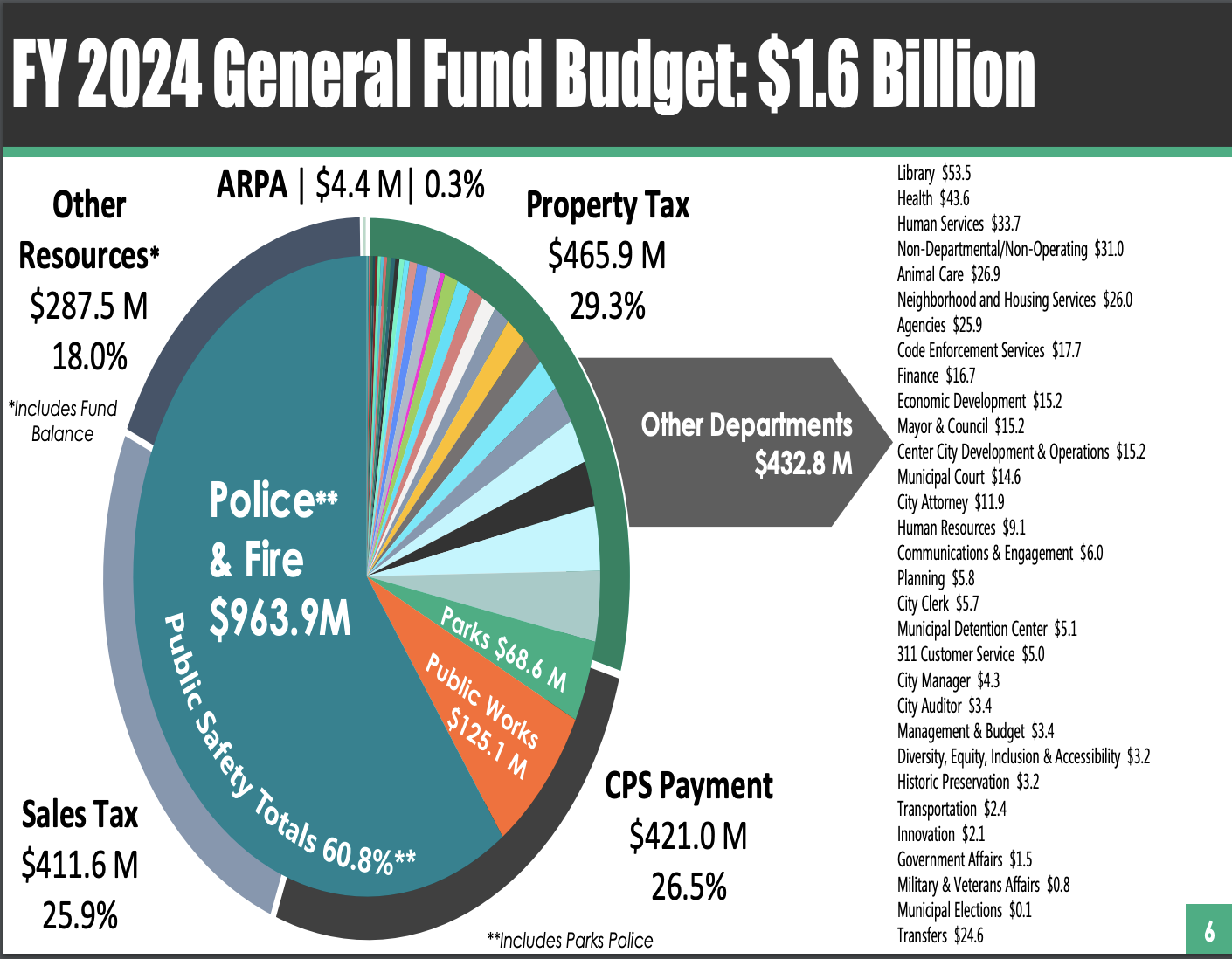
In 2024, the city’s proposed $1.6 billion General Fund budget comprises $465.9 million from property taxes, $411.6 million from city sales tax, $421 million from CPS Energy revenue, and $242 million in other revenue, such as unused funds from the previous year.
Property taxes
Broadly speaking, Texas law caps the amount of property tax revenue local governments can collect at 3.5% growth from the previous year, or else they risk triggering a vote on the tax rate. The 2019 law, known as SB2, was designed to curb the growth of city budgets.
“There are some exceptions in that calculation,” Deputy Chief Financial Officer Troy Elliott told the council Thursday. “So you will see growth above and beyond the 3.5% cap.”
For example, the cap does not apply to new construction and improvements, which presumably require additional city services. New property accounts for about $16.2 million in new property tax revenue this year, according to the city.
The law also allows local governments that don’t meet the revenue cap to carry over the unused increment for use in a future year — something San Antonio plans to do for the first time since the law was created in 2019.
In total, the budget will use about $50.1 million more in property tax revenue than the 2023 budget, about a 7% increase.
Elliott said SB 2 largely guides the city’s process for creating a new tax rate that brings revenue in line with the state cap.
The City Council must next hold two public hearings on the rate and then formally approve it after the council approves the budget on Sept. 14.
“The tax rate will change every year,” Elliott said. It “will fluctuate based on taxable values, based on state legislation [and] based on the action the council took as far as the exemptions.”
Does a lower rate mean savings?
In recent years, rapidly rising property valuations have outpaced the city’s rate reductions.
This year, however, Walsh told reporters the taxable value for the average home in San Antonio will go down, from $214,000 in 2023 to $205,000 in 2024, which means potentially lower tax bills for some homeowners.
That change comes as city leaders agreed to double the city’s homestead exemption this year, allowing homeowners to reduce the taxable value of their home by 20%.
According to the Bexar Appraisal District, about 5,100 new homestead exemption applications were processed between June 2022 and June 2023. Walsh said the city residents also filed a record-high number of appeals to their appraised values.
Property tax bills will be mailed out in October.
Qualified homeowners can still apply for the homestead exemption and have their savings applied retroactively for up to two years.
This article has been updated to clarify that Thursday’s vote was to propose the tax rate. A vote formally approving the rate would occur next month.