San Antonio City Council approved a plan to phase out horse-drawn carriages from city streets on Thursday, making it the first Texas city to approve such a ban.
A fight to end the practice has been playing out in major cities across the country, but a similar effort to ban the business in Dallas was recently shut down.
“If this can happen in Texas, this can happen anywhere,” said Mindy Patterson, president of the Cavalry Group, which lobbies on behalf of the horse-drawn carriage industry nationwide and has been trying for years to pass legislation in Texas to protect the industry.
City Council voted 10-0 Thursday on a plan that will phase out horse-drawn carriages over the course of five years. It stops the city from issuing new permits, and gradually scales back their hours of operation starting in 2027.
The carriages — which have been permitted in San Antonio since 1865 — are expected to be off the streets completely by Jan. 1, 2030.
The initial proposal laid out a quicker, three-year timeline. Councilman Marc Whyte (D10) proposed amending it from the floor, which was approved by a 6-5 vote.
Councilwoman Phyllis Viagran (D3), who co-authored the original proposal, said city staff had failed to provide a clear picture of how it would help the carriage industry members make a smooth transition. She threatened to withhold her support unless the longer five-year timeline was approved.
“I did not have enough information to see that this will be done equitably and fairly in three years,” Viagran said.
Councilman Manny Pelaez (D8) abstained from voting on the overall phaseout, saying five years wasn’t fast enough.
Record-breaking public input
In the nearly two years since Councilman Jalen McKee-Rodriguez (D2) and Viagran authored the initial council consideration request, the issue has sucked up countless hours of debate at City Hall and drawn an overwhelming response from advocates on both sides of the issue.
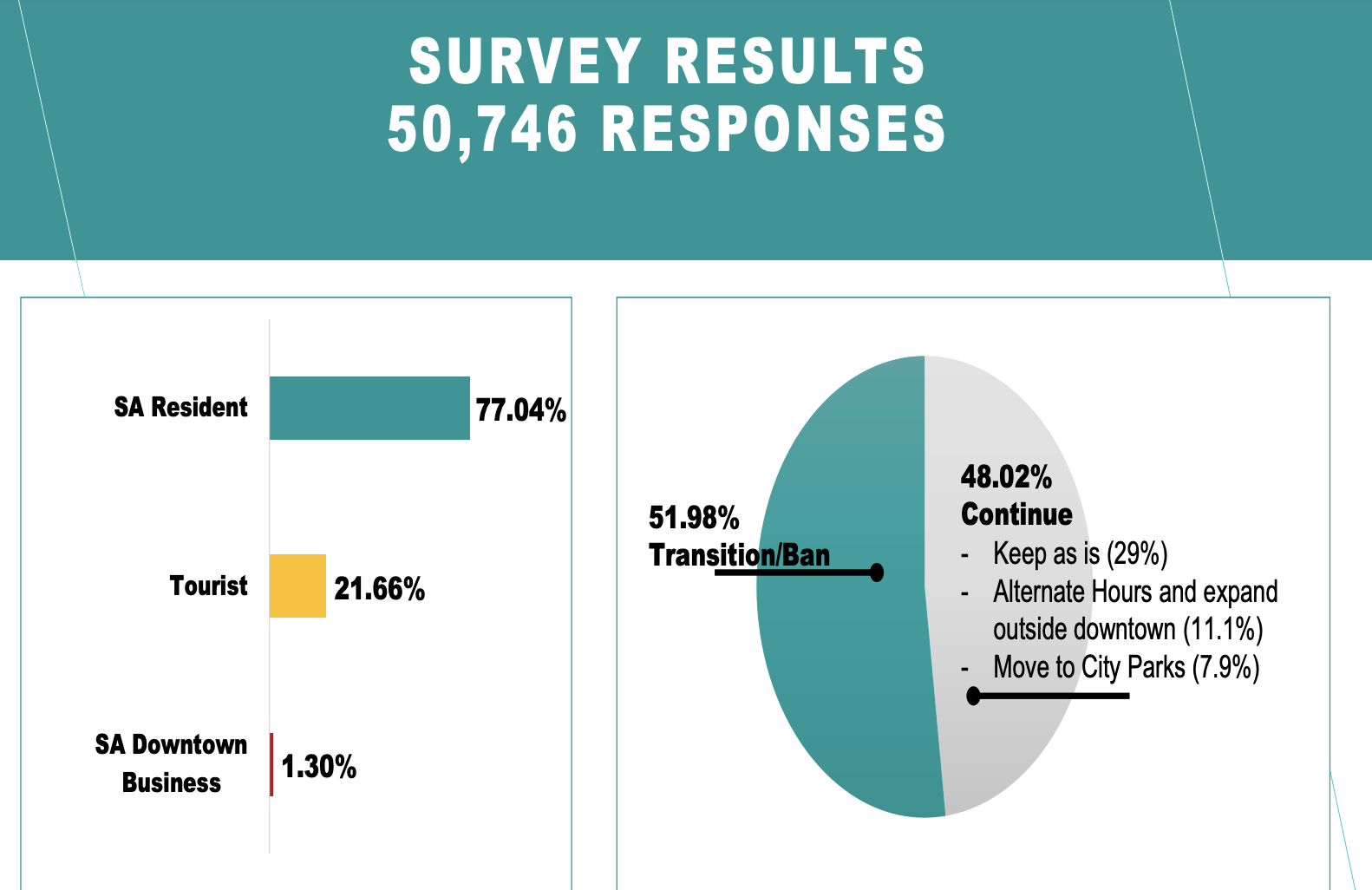
A city survey asking the public for input on how to address the issue drew a record 50,700 responses — split nearly evenly between those who wanted the carriages to stay and go.
While animal rights activists and transit proponents pushing to abolish the practice argue that it’s cruel and archaic, carriage operators have argued that city leaders are wiping out a piece of the local tourism industry in the interest of safety concerns that haven’t borne out.
Despite numerous examples of carriage horses in distress and accidents involving the carriages in other cities, there were almost none in San Antonio, which has taken major steps to regulate the industry.
“Cruelty doesn’t have to always be present in order for something to be still considered exploitation,” said Carter Graham, who signed up to speak in favor of the ban at Thursday’s council meeting. “They are still being viewed as a use, a means for profit, a symbol of entertainment and vanity, not as the sentient individuals that they are.”
Graham and other activists at Thursday’s meeting also called for liberating animals at the San Antonio Zoo, SeaWorld San Antonio and the San Antonio Stock Show and Rodeo.
Carriage company operators, meanwhile, have helped pack city meetings with farriers, large animal veterinarians and crying children to help make the case that city leaders know nothing about agriculture, and that ending their industry would put dozens of employees out of work.
“I beg of you to see what will happen to all these small businesses if you do this, not just my family, but countless families, the families that fix our wheels, the families that we buy our hay from,” said Devon Vaniman, a carriage driver who spoke in opposition to the ban on Thursday.
A plan to keep fighting
Patterson said the carriage company owners have engaged Attorney General Ken Paxton in their effort to make the case that San Antonio is violating a 2023 law created to prevent cities from over regulating commerce.
Though that law has been tied up in the courts, Patterson said San Antonio’s horse-drawn carriage ban could put it to the test.
“We’re hoping that Paxton will take action on this,” Patterson said. “There’s really nothing that his office could do, as they’ve told us, until the City Council actually bans a lawful business, and then he’ll be able to.”
San Antonio explored options to move the horse-drawn carriages to parks instead of city streets, as well as a transition to electric carriages. Neither of those ideas advanced.
The plan City Council approved lists several options to retrain the carriage industry employees for other jobs, including potential zero-interest loans for those who want to start a new business.
It does not mention career transitions for the horses — something several council members requested in earlier meetings.
Owners of the carriage companies have said many carriage horses wind up going to slaughter if they can’t work, because they’re so expensive to feed.
“You talk about sanctuaries that our horses can go to, are those sanctuaries going to pay off our debts, to take our animals?” said Kathy Stephens, who works for Bluebonnet and Lollipop Carriage Companies. “A bankruptcy court will come and take our assets. Because our largest assets to our company are our horses, and they will be sold at your highest bidder.”
Correction: This story has been updated to correctly refer to a speaker who advocated in favor of the ban at Thursday’s meeting.