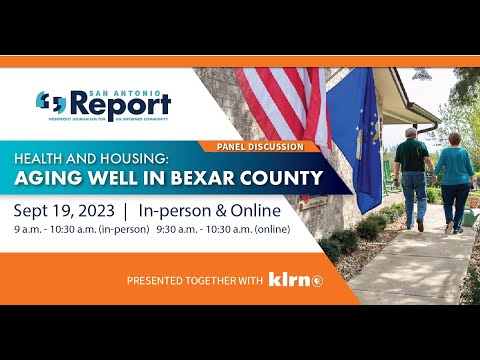
During a hybrid panel discussion co-hosted by the San Antonio Report and KLRN Tuesday, a panel of professionals who work with the city’s aging population shared resources and services available for people aged 60 and over, an age group which is expected to grow 20% by 2040. The discussion, titled Aging Well in Bexar County, focused on housing, transportation and caregiving for seniors in San Antonio, which are the greatest needs of the aging population, the panelists said.
“Finding an affordable unit and finding one that’s accessible is like finding a needle in a haystack, to be quite honest,” said Kristin Davila, president and executive director of Merced Housing Texas, a nonprofit organization that has three properties for low-income older adults.
Davila also serves on the city’s housing commission which oversees the Strategic Housing Implementation Plan (SHIP), a plan focused on affordable housing for seniors in San Antonio. The commission has identified 11,000 homes that need to be rehabbed, or improved, so that residents can age in place safely. Davila said there are many more homes in the city that need modifications to make them more accessible.
For low-income seniors living in unsafe conditions, Merced Housing Texas offers repairs at no cost.
“Saving for retirement is unfathomable when you’re living on a social security wage of $1,000 a month. That severely limits options available to you,” Davila said.
Another issue the aging population faces is risk of homelessness. The fastest growing population of people experiencing homelessness are aging adults, Davila said.
Davila added that many seniors live at that low income level, but struggle with costs of living silently because there’s no other way.
“The folks that are earning 30% of the area median income or less, about $20,000 for a single person or less, those are the ones that are having the most difficult time finding not only an affordable place to live, but one that’s safe and one that’s in healthy condition,” Davila said.
House sharing is another option the city is looking at, Davila said, where seniors would share homes with another aging person, like roommates, to keep them socially engaged and watch out for them. The city is also considering making more Merced Housing Texas units available to people at the lowest income levels.
A goal of the housing commission, Davila said, is to make it easier to develop accessory dwelling units or casitas so that older family members can age in their community and maintain social connections. This is important for an aging person’s brain health, said Dr. Sudha Seshadri, founding director of the Glenn Biggs Institute for Alzheimer’s and Neurodegenerative Diseases and a doctor at UT Health San Antonio.
One in five people will live with dementia before they die, Seshadri said, explaining that dementia is a syndrome that causes people to forget more recent memories, but remember emotional content and long-term memory.
“One of the things we believe really helps build brain resilience and prevent the symptoms as well as the progression [of dementia] is community, social, cognitive, meaningful engagement. The physical activity, the cognitive activity, the social engagement,” she said. “It’s very important that people be able to age in place and be able to connect, just as they used to.”
“Dementia is not an illness that affects one person. It affects a whole family, community, church, friends. For every one person with dementia, there are at least three others whose lives are turned upside down,” Seshadri added.
“In hand with housing is transportation,” said Jane Paccione, director of the San Antonio Area Foundation’s Successfully Aging and Living in San Antonio or SALSA program. “Latest studies show we outlive our driving abilities by about seven to 10 years.”
Paccione recommends seniors make a transportation plan to stay connected to their community.
“When we think about our aging in place plans, whether we’re aging in place with a disability or not, we need to make sure transportation and caregiver support is connected,” Paccione said.
“We can do it and we’re doing it here in San Antonio,” she said.
The San Antonio Area Foundation’s caregiver toolkit has different opportunities, Paccione said, and added that sacrd.org has resources like the Northeast Senior Assistance that offers free rides for older adults in different areas of San Antonio.
Local seniors can call Silver Connect to chat with someone over the phone, in English or Spanish. On average, conversations last about 20 minutes, Paccione said, and helps people feel connected.
To stay active and social, the panelists said even low-income seniors can age successfully by visiting senior centers, churches and places of worship.
Making the proper lifestyle choices and staying social can help us age well, Seshadri said.
“One thing we can all do is change the way we talk about aging and the way we think about aging,” Davila said. “It’s not, ‘I’m getting older.’ It’s ‘I’m getting older, I’m wiser and look what I’ve been able to accomplish.'”