Members of the San Antonio City Council will soon debate whether to ban oversized commercial vehicles, such as 18-wheelers, from parking overnight on city streets.
A proposal to do so, crafted by the San Antonio Police Department and presented to the Public Safety Committee on Tuesday, drew praise from council members who say constituents have made clear they’re unhappy with the vehicles clogging their streets and want the city to do something to address it.
“It can be a real public safety issue when you’ve got big 18-wheelers lined up on the side of a road, and cars have to swerve to miss them,” said Councilman Marc Whyte (D10), who serves on the Public Safety Committee and voted to advance the proposal to the full council Tuesday.
But whether the city has the ability to regulate the issue beyond what state law specifies is a question the plan’s lead proponent, Councilman Manny Pelaez (D8), has raised repeatedly over the past six months.
House Bill 2127, a new state law signed by Gov. Greg Abbott, seeks to prevent cities from creating a patchwork of regulations that make it more difficult for businesses to operate in multiple cities.
It does so by giving private citizens authority to sue local governments for maintaining ordinances in certain policy areas that the state already regulates, unless state law gives them express authority to do so.
San Antonio was among a coalition of cities that filed a suit against the state to stop the law from taking effect on Sept. 1, and a Travis County judge agreed that the law is unconstitutional in a ruling last month. The state has appealed that decision, but local leaders are vowing to keep working on ordinances regardless of how the law would apply.
“We can’t really figure out yet whether or not HB 2127, if left undisturbed by the [courts], would preempt this,” said Pelaez, who crafted the Council Resolution Request to address oversized commercial vehicles. “I think this is a pretty good test case for where exactly the boundaries are.”
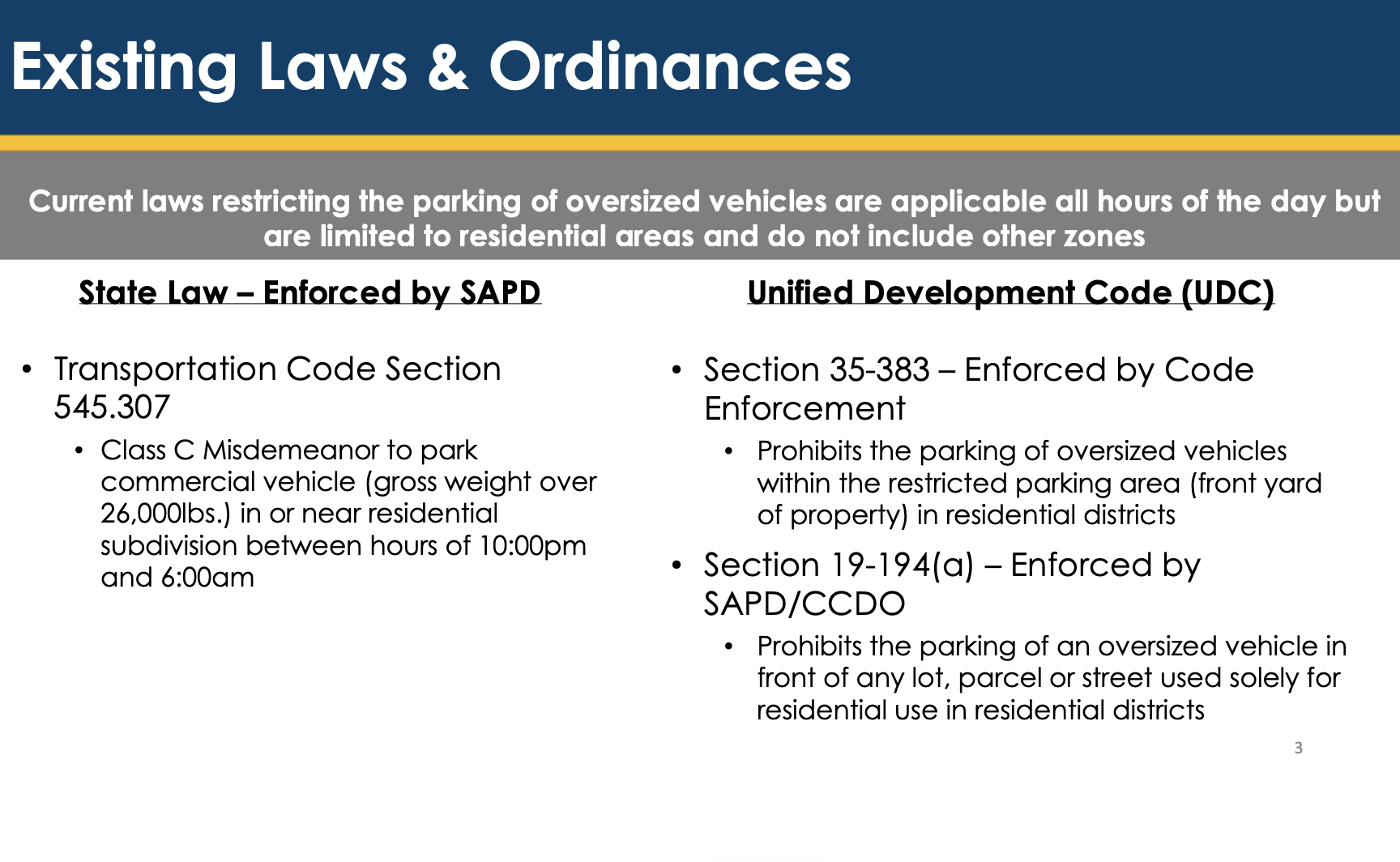
San Antonio and the state already have some rules restricting oversized commercial vehicles from parking in residential areas.
After looking into how other cities handle the issue, SAPD recommended updating the city’s Unified Development Code to also restrict the vehicles from parking in non-residential districts between 2 a.m. and 6 a.m., unless they are actively loading or unloading.
That change should crack down on oversized vehicles that are being stored on the street, not ones that are providing service to nearby businesses, SAPD Assistant Chief Robert Blanton told the committee Tuesday.
“It seems maybe the owners or operators of these trucks know where [there’s free space] available to park and so they’re doing so,” Blanton said. “It may be a cost of operating that business that you have to have some sort of storage.”
Whyte, the council’s lone conservative and a vocal supporter of HB 2127, said he believes those changes would not run afoul of the new state law.
“It doesn’t fall in one of the eight categories set forth by the bill,” Whyte said. “There’s a state transportation code… dealing with parking on residential streets, but transportation is not one of the eight areas that the preemption [includes].”
A preemption case study
To Pelaez, who often sides with the business community on an otherwise progressive council, the parking ordinance is a prime example of HB 2127’s failures.
Proponents of the law — mostly business groups — said it was designed primarily to stop cities from regulating workforce issues, such as mandating paid sick leave, or heat breaks for construction workers.
But there are “some very practical not controversial issues” that are also impacted, Pelaez said.
In response to overwhelming complaints from residents and business owners about commercial vehicles parked on city streets, Pelaez said he submitted the CCR in May of 2022 asking city staff to explore options to address the issue. He pointed to streets that lead into residential neighborhoods, such as Beckwith Boulevard and Parkdale Street in his northwest council district, as examples of the biggest problems.
“We’ve even had some office property owners complaining that their own clients and employees weren’t able to get in and out of their parking lots safely,” Pelaez said.
But Tuesday’s Public Safety Committee meeting also highlighted some of the issues HB 2127 was intended to address, like the challenge businesses face keeping up with a patchwork of regulations from city to city.
“A lot of these people are passing through town so they come in, they stay at a hotel for a night and leave,” said Councilwoman Sukh Kaur (D1). “How would they know what the new ordinance is… especially if it’s different in Austin than it is here?”
Deputy City Manager María Villagómez said the city would work on a communications plan to accompany the potential new ordinance.
The proposal also hasn’t received input from some of the businesses that would be most impacted.
“Have we talked to any of the trucker associations or folks that represent truckers to get their perspective?” Kaur asked. Blanton said the police department had not.
Whyte said after the meeting that HB 2127 will eventually limit some of the solutions council offers to address community problems. When that happens, he said, the city should use its government affairs team to appeal to the legislature for help.
“At some point, we are going to run into something that does fall within one of those eight categories… But if it’s preempted, then that’s the law, and we have to live with it,” Whyte said. “As the mayor said, we’ve got to do things at the appropriate level of government.”